
The John Butcher Poster Prize
The annual John Butcher Poster Prize for students and early-career researchers (up to five years past PhD) was established by the NZ Branch of ANZIAM in 2026 in honour of John Butcher.
The John Butcher Poster Prize recognises the lasting legacy of John Butcher's contributions to numerical analysis. The prize has a value of NZ$500 and is awarded annually at the Colloquium of the New Zealand Mathematical Society for the best poster in any area of mathematics that is presented by a student or early-career researcher (up to five years past PhD). The John Butcher Poster Prize has been in place since 2026 and replaces the John Butcher Prize in Numerical Analysis that was awarded biennially from 2005 until 2024 at the SciCADE conferences. |
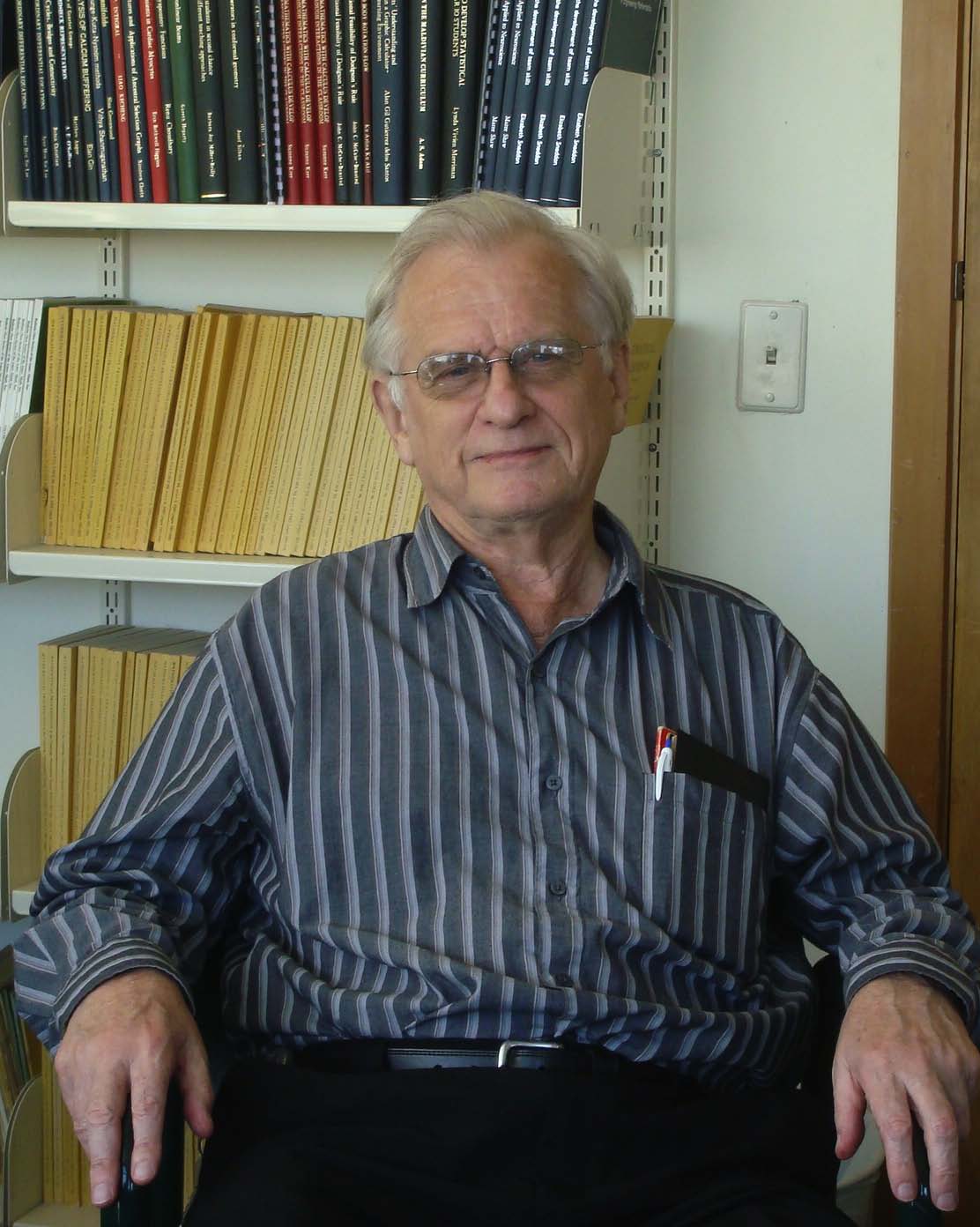
 Photo Credit: Mark McGuinness (2009) |
Biography of John C. Butcher
John Butcher was born on 31st March 1933 in Auckland, NZ. He began his studies in Mathematics in 1952, at the University of New Zealand (Auckland University College), and obtained his BSc and MSc in 1955 and 1956, respectively. He then went overseas for his doctoral studies at the University of Sydney, where he obtained his PhD in 1961. (In 1971, he was also awarded a DSc from the University of Sydney.) He held the positions of Lecturer at the University of Sydney, 1959–1961; Senior Lecturer at the University of Canterbury, 1961–1964; and Computer Scientist at the Stanford Linear Accelerator Center, 1965–1966.
In 1966, John Butcher was appointed Professor of Mathematics and Head of the Mathematics department at the University of Auckland. Apart from a period of ten years as inaugural Professor of the Computer Science department, he was Professor of Mathematics at the University of Auckland until 1998. Since his retirement in 1999, he is Emeritus Professor and remains affiliated with the department in an honourary capacity.
 |
John Butcher's research interests are in numerical methods for the solution of ordinary differential equations. He is famous for deriving the general geometric framework to design explicit high-order Runge-Kutta methods. The numerical methods that he discovered, and others that have been developed using his methods, are at the core of all modern numerical methods for evolution equations, from chaos theory to precise orbital tracking of satellites. The objects he introduced and studied, such as the Butcher group and B-series named after him, have had far-reaching ramifications across many branches of mathematics and theoretical physics, that continue to this day. |
Fields medallist Alain Connes wrote:
"We regard Butcher's work on the classification of numerical integration methods as an impressive example that concrete problem-oriented work can lead to far-reaching conceptual results."
Below follows a brief description that gives some idea of Butcher's achievements. The formulation and error analysis of the well-known fourth-order Runge-Kutta method is typically covered in any undergraduate Numerical Analysis course as an example of a multistage method for initial value problems (IVPs). Therefore, we start with the formulation of this numerical approximation to the solution \(y : \mathbb{R} \to \mathbb{R}^n\) of the IVP
Carl David Tolmé Runge (1856–1927) viewed the IVP as a stepwise quadrature problem, employing the fundamental rule of calculus to approximate the function value \(y_1\) at time \(x_1 = x_0 + h\) for some chosen stepsize \(h\). Wilhelm Martin Kutta (1867–1944) was the person who used these ideas for what is now the classical fourth-order Runge-Kutta method, defined as
with the so-called slopes given by
These rather elaborate instructions are nowadays typically given in the form of a Butcher tableau, in the case of the classical fourth-order Runge-Kutta method, given as
If the right-hand side \(f\) does not depend on the solution \(y\) itself then the solution to the IVP reduces to a simple integral; in this case, it is easy to see that the classical fourth-order Runge-Kutta method has its origins in the quadrature rule known as Simpson's rule. Note that the evaluation of Simpson's rule is exact for polynomial functions of degree at most 3.
In general, the order of a Runge-Kutta method must be derived from Taylor expansions in the stepsize \(h\), which is a very elaborate process of verifying equality of various terms, known as the order conditions. To design a new, higher-order Runge-Kutta method, one needs to derive the order conditions in terms of the (unknown) coefficients in the Butcher tableau, which are then solved for such that the order becomes as high as possible. In 1963, as a PhD student himself, John Butcher discovered a very elegant way to calculate the coefficients and obtain order conditions in complete generality for Runge–Kutta methods of autonomous IVPs, that is, when the right-hand side \(f\) does not depend \(x\). Previous studies had laboriously expanded the solutions of particular (e.g. explicit) methods by hand, so this was an enormously important development.
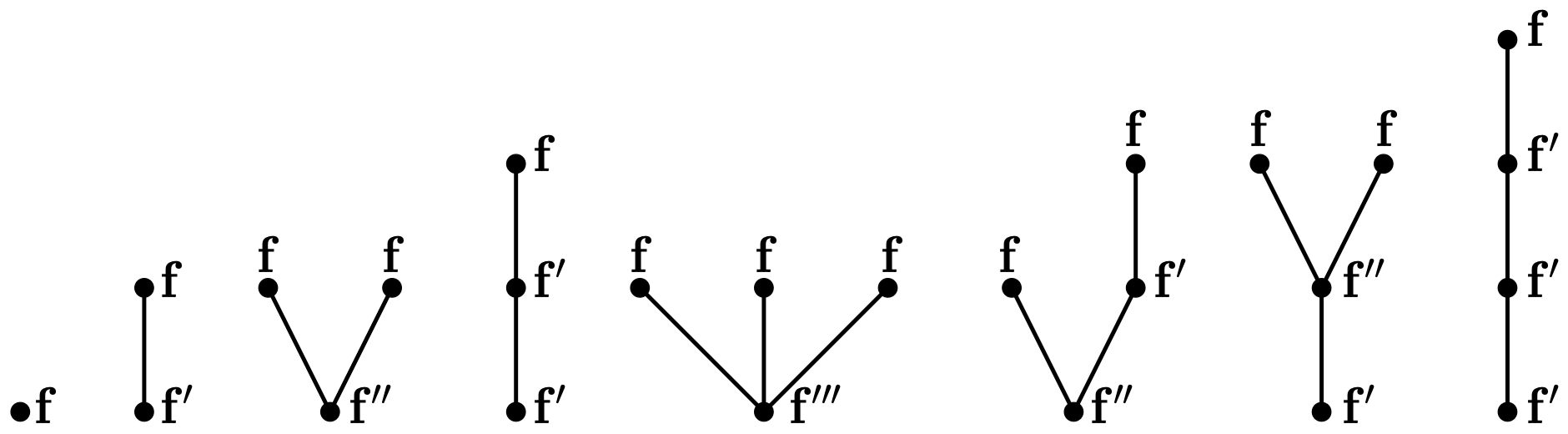
John Butcher's approach built on the century-old foundations of graph theory laid by Cayley and a 1957 paper by Merson that explains the structure of elementary differentials, as obtained in these Taylor expansions. Merson showed that these elementary differentials are in one-to-one correspondence with so-called rooted trees introduced by Cayley. Taking the fourth-order Runge–Kutta method as an example, Butcher writes the higher derivatives of \(y(x)\) in a compact form, defining \(\mathbf{f} = f(y(x))\), \(\mathbf{f}^\prime = f^\prime (y(x))\), \(\mathbf{f}^{\prime\prime} = f^{\prime\prime}(y(x))\), etc., using repeated differentiation and the chain rule:
The terms occurring in these expressions correspond exactly to the rooted trees with 1, 2, 3, and 4 vertices. This is illustrated in the picture below.
Merson still carried out the required Taylor series expansions in elemenary differentials term by term. Although this labourious process was greatly simplified by the use of elementary differentials and rooted trees, he did not have the coefficients of all elementary differentials at once, as Butcher achieved.
For further details, we refer to the paper "Runge-Kutta methods: some historical notes" by John Butcher and Gerhard Wanner [Applied Numerical Mathematics 22(1-3):113‐151 (1996)]; see also the newsletter article "Butcher Series: A Story of Rooted Trees and Numerical Methods for Evolution Equations" by Robert McLachlan, Klas Modin, Hans Munthe-Kaas and Oliver Verdier [Asia Pacific Mathematics Newsletter 17(1):1–11 (2017)].
John Butcher was appointed an Officer of the New Zealand Order of Merit, for services to mathematics, in the 2013 Queen's Birthday Honours. Further accolades acknowledging his achievements have been the election to Fellow of the Royal Society of New Zealand (1980), Fellow of the New Zealand Mathematical Society (1999), and inaugural Fellow of the Society for Industrial and Applied Mathematics (2009). John Butcher has further been honoured with the NZMS Research Award (1991), the Hector Memorial Medal from the Royal Society of New Zealand (1996), the Jones Medal from the Royal Society of New Zealand (2010), and jointly with Éva Tardos, the Van Wijngaarden Award (2011).